Jo Sear
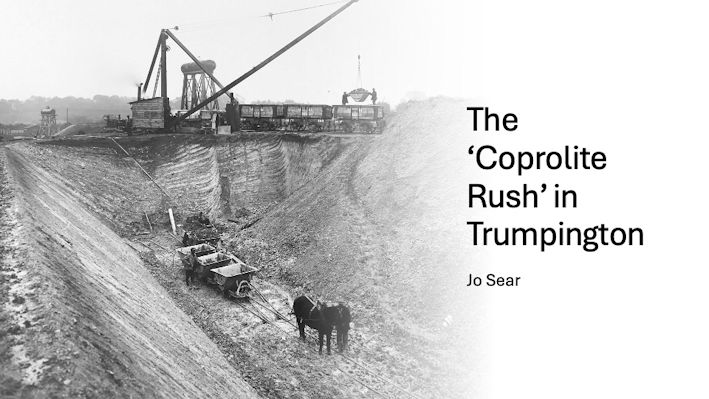
In the late nineteenth century, coprolite mining in certain areas of Bedfordshire and Cambridgeshire was a massive venture which involved significant numbers of people. Not only that, but it provided the raw material for the world’s first chemical fertiliser and involved the first large scale open cast mining to take place in the British Isles (Grove 1974a, p. 3). This paper will give a brief outline of the development and subsequent decline of the coprolite industry and relate it to Trumpington because Trumpington was heavily involved in the coprolite industry in both the late nineteenth and early twentieth centuries.
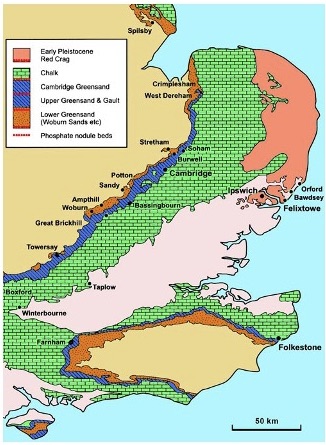
The term ‘coprolite’ comes from the Greek ‘kopros’ for ‘dung’, and ‘lithos’, for ‘stone’ and was coined in 1829 by the Reverend William Buckland, first professor of geology and mineralogy at the University of Oxford. The famous fossil hunter Mary Anning had noticed that stony objects known as ‘bezoar stones’ were often found in the abdominal region of ichthyosaur skeletons which she’d found at Lyme Regis. These observations by Anning led Buckland to propose in 1829 that the stones were fossilised faeces. He coined the name ‘coprolite’ for them and the name came to be the general name for all fossilised faeces. Before long, it became clear that this was not an isolated find and that thick seams of the fossilized remains of animals that had succumbed to a major rise in sea level millenniums earlier were to be found in various places throughout England. For example, the polymath Professor John Stevens Henslow, then of the Botany Department at St John’s College, Cambridge, mentor of Charles Darwin and driving force behind the foundation of the Botanic Gardens, found similar material at Felixstowe in Suffolk. At this stage it was also noted that true dinosaur faeces were found to represent but a very small proportion of most coprolite beds, and that in most cases, the so-called coprolites were actually the shells and internal casts of mollusca. Fossilization occurs when the empty spaces within a buried organism fill with water rich in minerals that combine with the organism’s natural chemicals to form a solid deposit. In the case of coprolites, that deposit is calcium phosphate or phosphate of lime (Grove 1974a, p. 4). Henslow recognised this and recognised that coprolites would provide a highly concentrated fertilizer. This was at a time when farmers were starting to struggle to produce enough food to feed a growing population, with a very real concern that farm production would not keep pace with population growth unless crop yields could be increased. Henslow conducted experiments, published his results and gave an influential lecture to the British Association for the Advancement of Science in 1845 in which he identified that coprolites with ‘a stratum of Greensand, although never more than a foot thick, occurred near the surface over many square miles in the vicinity of Cambridge’ (Grove 1974a, p. 7). Figure 1 shows this band of Cambridge Greensand in blue, stretching right across Bedfordshire and Cambridgeshire and just touching on Trumpington.
However, although this was known by the 1850s, there is very little evidence of coprolite mining until a coprolite bed was discovered at Coldham’s Common in 1858 (Grove 1974a, p. 9). From this date onwards, coprolite mining took off. The most common arrangement was that a landowner who farmed land on the Greensand ‘belt’ would realise the potential benefit of what lay beneath his land and would let it out to a dedicated coprolite mining firm. Alternatively, he would consult a local land agent who would make the facts known about the potential of the land and tender out the contract. In a few cases, a concern dealing with coprolites might approach a landowner to negotiate the terms for renting out the land and extracting the mineral (Grove 1974a, pp. 12–16).
The actual extraction of the coprolites followed a standard procedure. A long, narrow strip of topsoil was removed and a trench was prepared with the topsoil put to one side. If the coprolite bed was more than eight or nine feet down, the trench would be stepped for safety and plank walks and barrow runs would be constructed (Figure 2). In this image of coprolite digging at Orwell, just down the A603 from Trumpington, it is possible to see the quite treacherous plank and barrow runs.
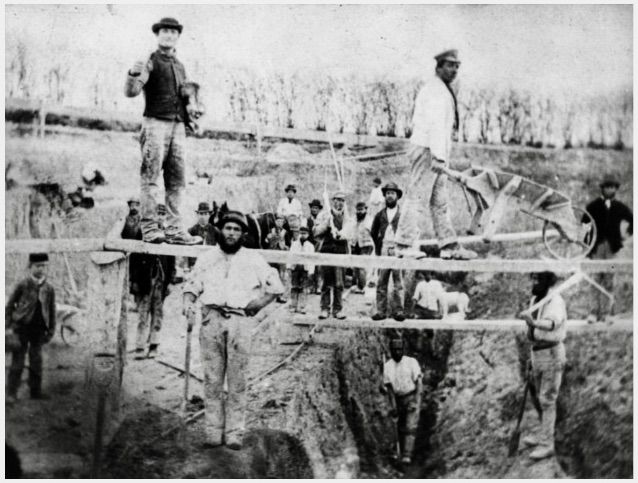
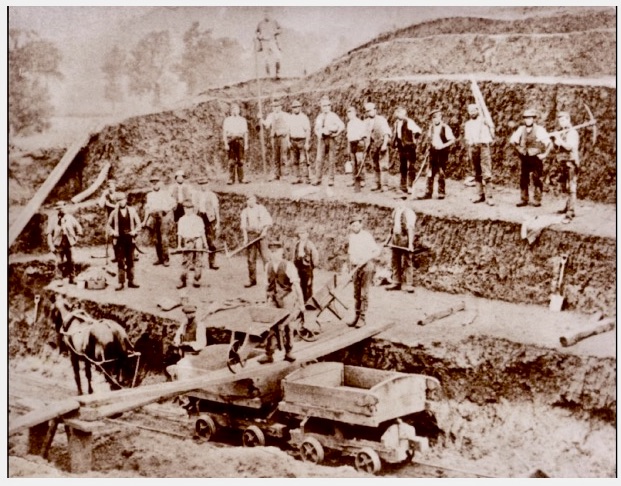
Once the trench had been dug and the runs constructed, the diggers would remove the coprolite nodules from the bed and shovel them into wheelbarrows, as in Figure 2, or, later on, trucks which were pushed by hand or pulled by horses along a tramway out of the pit as in Figure 3 which shows a coprolite mining operation in Great Brickhill, Buckinghamshire.
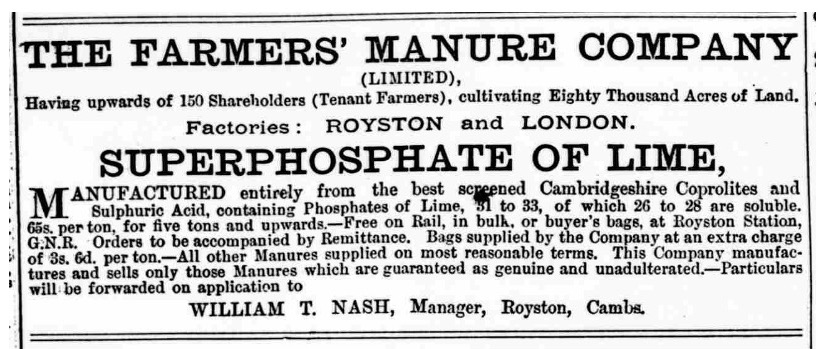
The raised coprolites would still be covered in sticky gault clay or marl which had to be washed off. This would usually be done on site as the weight of the waste material would add a considerable cost to transport. In the early days of coprolite mining, washing took place in water-filled trenches, or even a local river. Over time, however, more efficient ways were developed and, in particular, on site circular iron water tanks. Once washed, the coprolites would be transported for processing at a processing plant. In the early days of the Cambridgeshire industry, most of the coprolites were taken to London for processing at the Lawes Chemical Company on the banks of the Thames but, over time, local processing sites were established on East Street and Histon Road in Cambridge, as well as in Duxford, Shepreth, Royston and Bassingbourn. Regardless of which site was used, the coprolites were ground to a powder which was then treated with warm sulphuric acid to form the superphosphate fertiliser. This was then be sold on to farmers (Figure 4), as shown by this advert from the Farmers’ Manure Company advertising the sale of the best screened Cambridgeshire coprolites.
Back at the coprolite site, it was a continuous process. When one coprolite trench was exhausted, another would be dug and the soil from the second trench would be used to fill the first trench. When the extraction process on a particular piece of land was complete, the land was put back to agricultural use.
From the 1860s onwards, digging for coprolites had become a huge industry in Cambridgeshire with three main phases and two main areas of coprolite digging. From 1858 to 1880, coprolite mining mainly took place to the south of Cambridge (including Trumpington); from around 1872 it moved to the Fenland edge, particularly around the Swaffhams and Burwell; and then, from the end of 1917 to late 1918, it returned to Trumpington and Grantchester (Grove 1974a, p. 4).
The nineteenth-century coprolite industry did not start until the late 1850s and by the end of the century, it was largely over. This was for two main reasons: increasingly, the shallower seams were exhausted and it became more difficult, and thus more expensive, to extract the coprolite; but, more importantly, at the same time, huge rock phosphate deposits were discovered in the United States and elsewhere and cheap fertilizer from these deposits were beginning to flood Europe. In 1875, 258,150 tons of coprolite were produced in England, by 1880 production had fallen to 30,500 tons, and by 1900 it was just 620 tons (Grove 1974a, p. 30).
In the 1861 census for Trumpington, only one man is recorded as having anything to do with the coprolite industry. James Smith, who lived at 18 London Road with his wife and two small children, was recorded as a foreman coprolite digger, but is unlikely to have worked in Trumpington as there is no record of any coprolite workings in Trumpington at that time. Ten years later, that situation had clearly turned around. When the census was taken in 1871, 52 Trumpington men gave their occupation as ‘coprolite labourer’. Many of these men had been recorded in the earlier census as living in Trumpington, but worked as labourers or agricultural labourers, so they had evidently decided to take advantage of the better pay that coprolite mining offered. Other men recorded in the census were clearly from outside the village and had migrated in to take advantage of the work being offered. This peripatetic nature of coprolite labourers was a feature of the industry, with men moving from site to site for work. It is perhaps no surprise that a number of the coprolite labourers recorded for Trumpington are recorded as being lodgers, including four men staying at the Coach and Horses.
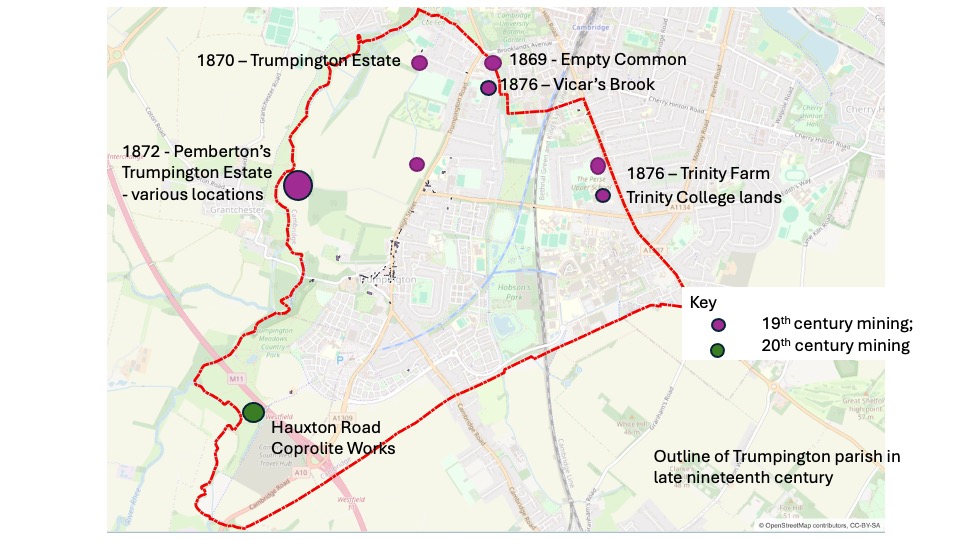
Unfortunately, surviving records of the coprolite industry in Trumpington are few, but from hints and suggestions in various sources, it is possible to identify that between the 1860s and 1880s, coprolite was mined at various locations across the parish (Figure 5) (O’Connor 1999, Trinity Library, 20 Trumpington 87, 97). In particular, between 1870 and 1879 coprolites were mined in large quantities on the Trumpington Estate with estimates suggesting that the estate received well over £23,000 for this (O’Connor 1999, p. 19). One area of the parish which was not mined despite the existence of known coprolite deposits was the estate attached to Anstey Hall which, at that time, belonged to the banker Ebenezer Foster. He was approached, but a price could not be agreed and so no coprolite extraction took place (O’Connor 1999, p. 23).
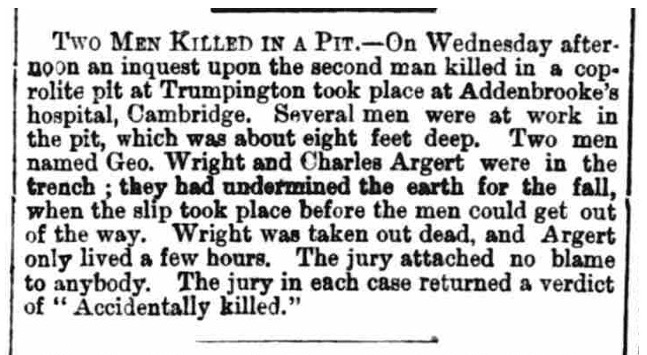
Coprolite mining was both hard work and dangerous, as confirmed by a number of newspaper reports which referred to accidents at Trumpington. In 1876, for example, two men were killed in a trench when earth that they had undermined slipped and buried them (Figure 6). At the inquest into their deaths, it was noted that previous accidents had occurred at the pit although none of these resulted in mortalities. As a result of being both hard work and dangerous, wages for coprolite workers were higher than for agricultural labourers; average weekly wages were 20-25 shillings, which was two to three times those of an agricultural labourer (Grove 1974, 42). The men spent money freely, especially in the numerous pubs that opened. Coprolite miners turned out to be a huge boost to the local economy, with blacksmiths, carpenters, boot makers and particularly brewers benefiting. Other people put up cheap accommodation to rent out and it is worth noting that a number of the coprolite miners in Trumpington are referred to as being lodgers.
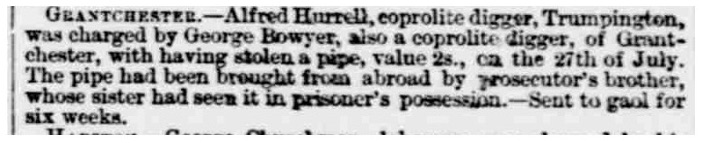
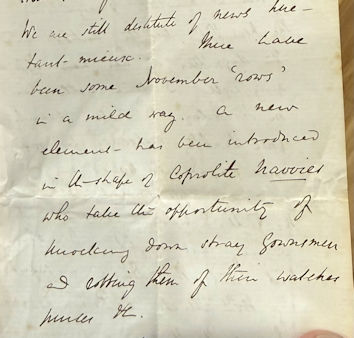
Unfortunately, it was not all good. Prostitution was known to have flourished in coprolite mining areas, and there were also reports of drunkenness, theft, rape and assault. Again, there are a few examples from Trumpington, including this theft of a 2s pipe by Alfred Hurrell (Figure 7), and Antony Pemberton showed a letter which had been sent to his grandfather by a Cambridge student which referred to coprolite ‘navvies’ knocking down students and robbing them of their watches (Figure 8).
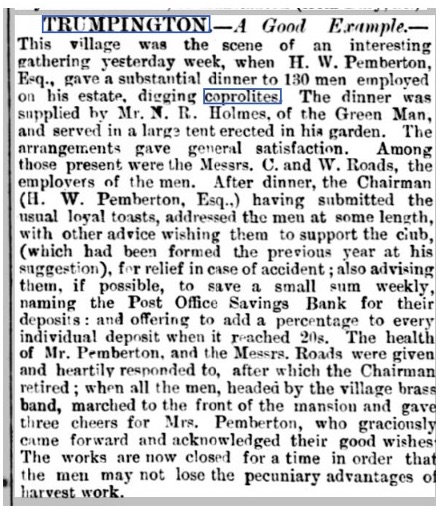
However, many benefits did accrue to the farmers and landowners who sold licences to extract coprolites, as they invariably received far more from the proceeds of coprolite mining on their land compared to their agricultural worth. Some landowners made a considerable amount of money from the coprolite mining on their lands and were often keen to plough some of this money back into the local community, as appears to have been the case with the Trumpington Estate and the Pemberton family. Figure 9 is a report from the Cambridge Chronicle reporting on a substantial dinner which H.W. Pemberton, Esq., gave to 130 men employed on his estate digging coprolites. The dinner was supplied by Mr N.R. Holmes of the Green Man and served in a tent erected in his garden. Not only did H.W. Pemberton pay for the meal, but when he addressed the men after the dinner, he urged them to save at the Post Office Savings Bank and offered to add a percentage to every individual deposit.
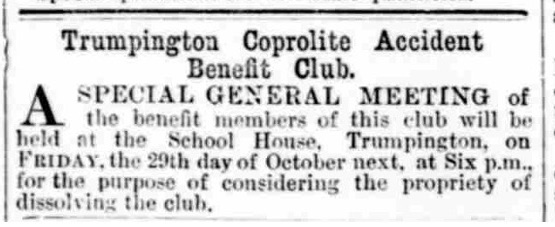
Unfortunately, this situation was not to last. The coprolite pits in Trumpington were probably closed down in 1880 as in October of that year, the Cambridge Independent Press reported on a special general meeting of the Trumpington Coprolite Accident Benefit Club convened for the purpose of dissolving the club (Figure 10). In the census taken in 1881, no coprolite diggers are recorded for Trumpington with many of the coprolite workers of ten years’ earlier disappearing from Trumpington altogether. Some of them, such as James Darnell, formerly of Swan’s Yard, moved elsewhere to mine coprolites, in the case of Darnell, to Great Eversden. Others did stay in the village and found other employment, usually as agricultural labourers.
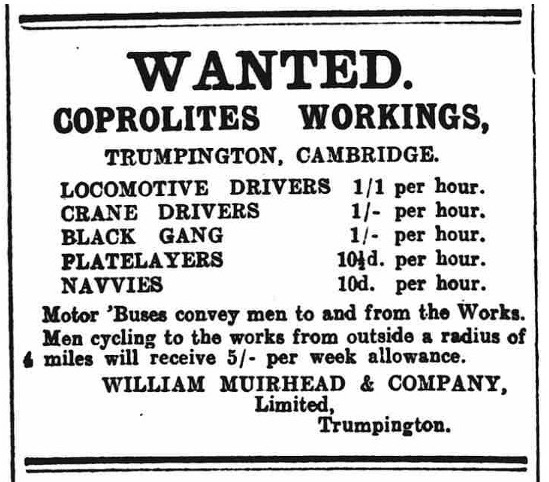
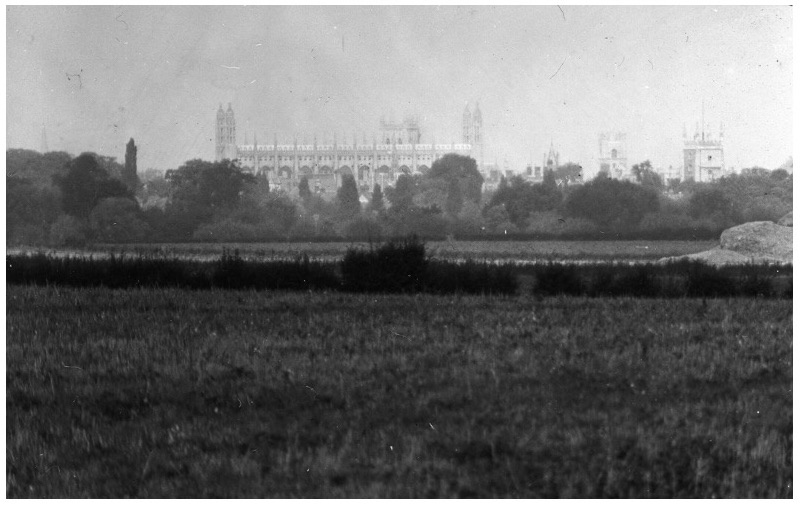
After the outbreak of the First World War in 1914, overseas supplies of phosphates were increasingly difficult to import because of attacks on merchant shipping. This created a need for domestic sources of phosphates, both for fertiliser, but also for munitions production. The Ministry of Munitions was established to take control of all raw materials and a report by the Fertiliser Manufacturers Association concluded that two possible sites were worth exploiting; fields belonging to the Anstey Hall estate and the fields between Cantelupe Farm and Manor Farm in Grantchester (O’Connor 1999). This time around, the new owner of Anstey Hall, Charles Finch Foster, son of Ebenezer, gave permission for coprolite extraction from his estate. These coprolite pits were to the south of the parish, in the fields between the river and Hauxton Road. What became known as the ‘Hauxton Road Coprolite Works’ got underway in October 1917, and in December 1917 and January of the following year adverts appeared in the local press recruiting workers (Figure 11).
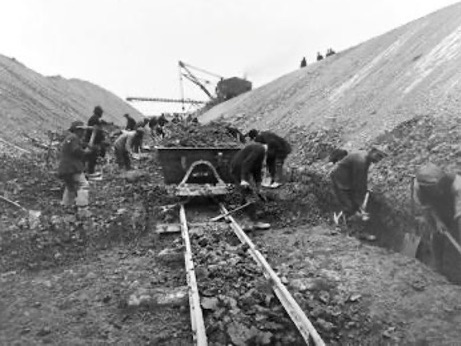
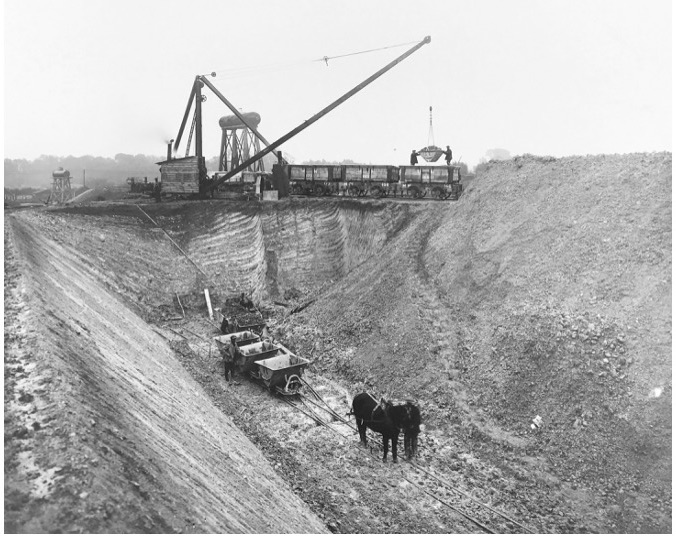
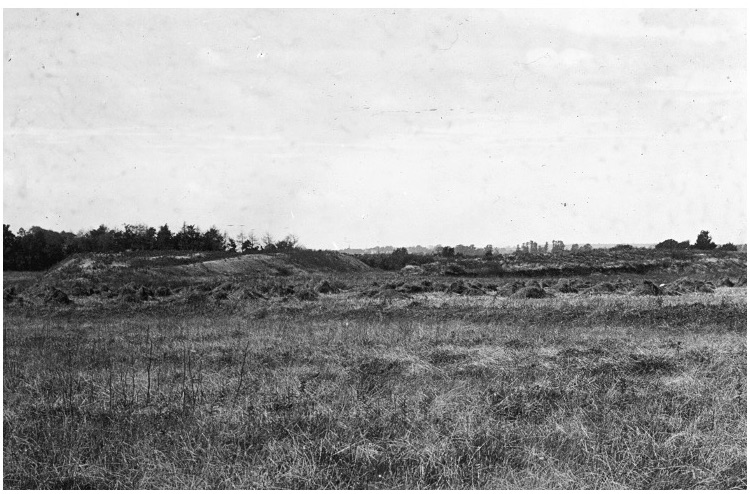
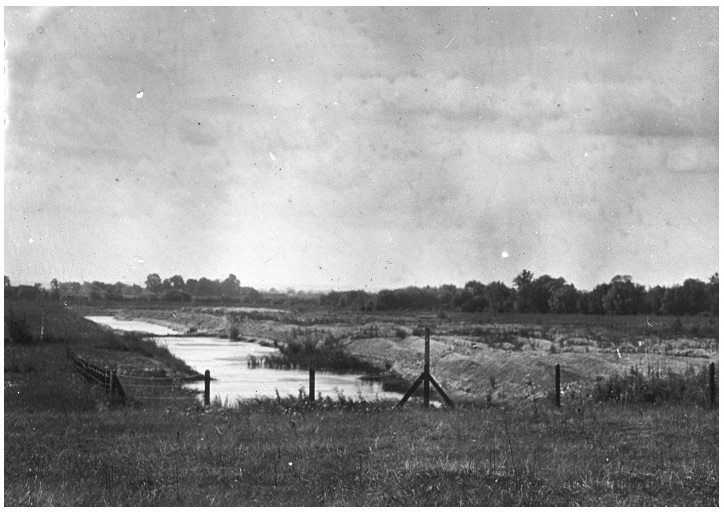
It was quite a considerable enterprise which aimed to extract as many coprolites in one year as had been achieved over the whole of the 1870s, using thousands of men including prisoners, students and Irish conscripts. Over £77,000 was spent on the works, which included the construction of an extension to the Cambridge to Bletchley railway line with a steel bridge to cross the brook, accommodation blocks to house workers and dedicated wash mills with sediment ponds (O’Connor 1999, p. 28–9). These coprolite pits were dug using draglines and were consequently much deeper than previous pits, although labourers were still required to shovel the coprolites into waiting wagons. Some images of these coprolite pits have survived (Figures 12–16). The first two, courtesy of Henry Boot and Son, the company who oversaw the site, show the pit in operation: firstly, labourers digging for coprolites and loading them onto a wagon; secondly, a pause in the work with horses waiting to pull filled wagons out of the pit. The final three, from the Percy Robinson Collection, show the diggings.
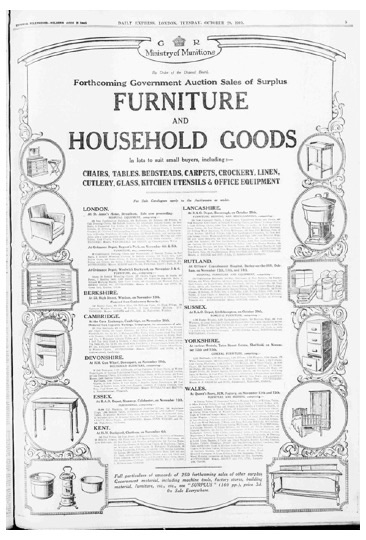
Unfortunately, much of the outlay was in vain. It is not known how much coprolite was even raised from the beds, but by November 1918 the war was over, as was the need for domestic coprolites as imports resumed. In October 1919 the fixtures and fittings of the Trumpington coprolite works were put up for auction by the Ministry of Munitions (Figure 17). The sale included 280 iron bedsteads, 400 mattresses and 700 sheets from the Trumpington site, so it was planned to be a significant operation. In the following month, the Trumpington and Grantchester diggings themselves were put up for sale.
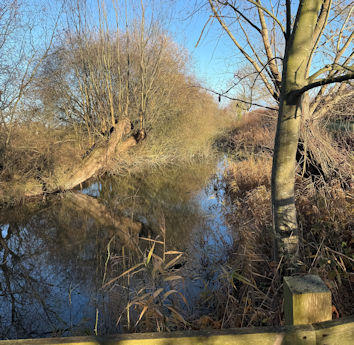
That was the final death knell for the domestic coprolite industry, but there are a few reminders, both in Trumpington and further afield. Very little visual evidence of the nineteenth-century coprolite diggings remains today as the manner in which the coprolite pits were dug, with soil from a second and subsequent pits used to fill earlier pits, meant that the impact on the landscape was minimal, particularly since many landowners imposed contractual conditions requiring the land to be restored for continued agriculture once the coprolites had been removed. As a result, it is difficult to find evidence of coprolite mining in the landscape, particularly if the land was subsequently used for crops and consequently ploughed. However, there are occasional glimpses, such as at Coldham’s Common where the land was returned to grass. Aerial photographs show a ribbed pattern on the landscape resulting from parallel trenches being dug across the landscape. As regards the twentieth-century diggings, there is evidence of coprolite mining in the form of the long, water-filled pit in Trumpington Meadows Nature Reserve (Figure 18). This pit was dug much deeper than the nineteenth-century pits and, presumably given that it was war time, without the requirement to ensure that the land was subsequently suitable to be returned to agricultural use.
In addition, although we would not necessarily link it to the coprolite industry, there is another reminder in Trumpington. Although the National School building dates back to 1843, records show that part of the income from coprolites was used from 1867 onwards to repair the school room, construct the school garden and build its walls, with most of the money from the project coming from the Trumpington Estate and as a result of the proceeds from coprolite mining (O’Connor 1999, p. 20.).
On a wider field, income generated from the coprolite industry in the Cambridge area was responsible for funding the building or rebuilding of a range of university, public and civic buildings. Although Addenbrookes Hospital was founded in 1719 (then in Trumpington Street), it underwent significant expansion in the late nineteenth century both in terms of physical additions and in extending its nursing and medical education. At this time, such expansion was largely made possible through charitable subscriptions and donations and, again, many of the donors were local gentry who had made money from coprolite mining (Welch 2018, O’Connor, 2009, Private collection, Whitechurch family papers). The Cambridge Corn Exchange, now a concert venue rather than used for its original purpose, was also produced as a result of the coprolite industry. A ‘corn exchange’ building had existed in Cambridge since the early 1800s, but in 1868 the Corporation decided to use some of the income that it had received from coprolite licences to build a new Corn Exchange building which was formally opened on 6 November 1875 (Extracts from The Cambridge Papers Relating to the Corn Exchange Question from 1865 to 1871, Vol. 3.).
Finally, many of the fossils held in the Sedgewick Museum were discovered as a result of the coprolite industry. Coprolite diggers frequently passed significant fossil finds on to Cambridge geologists, whilst many of these academics frequented the coprolite sites to view the diggings and to pick up items of interest.
So, a largely forgotten industry, but with a lasting impact on the history of Trumpington and the wider community.
Acknowledgements
Thanks are due to previous researchers who have explored the coprolite industry in Trumpington and, in particular, the notes prepared by Arthur Brookes, Margaret Marrs and Peter Dawson. Thanks are also due to Michael Hendy for the loan of his material on the coprolite industry and, in particular, the aerial photograph of the Plant Breeding Institute in 1975, showing the coprolite pit and spoil heaps prior to the construction of the M11 which was on display at the talk.
References
Cambridgeshire Libraries/Local Studies Collection, C:01:C61.1, Extracts from The Cambridge Papers Relating to the Corn Exchange Question from 1865 to 1871, Vol. 3.
Private collection. Whitechurch family papers.
Trinity Library, 20 Trumpington 87. 1870–81, parcel of plans and tracings of parts of the Trumpington estate, showing coprolite diggings thereupon, 7 items.
Trinity Library, 20 Trumpington 97. 9 Jun. 1880, the Master, etc. of Trinity College, Cambridge to Alfred Jones. Duplicate agreement for excavation of coprolites from an allotment of land in the parish of Trumpington bounded on the east by the London Road and on the south by the Via Lambertina.
Ford, T.D. and O’Connor, B. (2009). ‘A vanished industry: coprolite mining’, in Mercian Geologist, 1 (2), 93–100.
Grove, R. (1974a), The Cambridge Coprolite Mining Rush. Oleander Press: Cambridge.
Grove, R., (1974b). ‘Coprolite mining in Cambridgeshire’, Agricultural History Review, 24, 36–43.
O’Connor, B. (2009). The Cambridge Fossil Diggings. No place of publication.
O’Connor, B. (1999). The Trumpington Fossil Diggings. An Account of the Nineteenth-Century Coprolite Diggings. No place of publication. Welch, E. (2018). The NHS at 70. A Living History. Pen and Sword History: Barnsley.