David Stubbings, June 2026
We are grateful to David Stubbings for his recollections of bell ringing in the 1950s. David has also contributed other stories about the Recreation Ground and Glebe Farm.
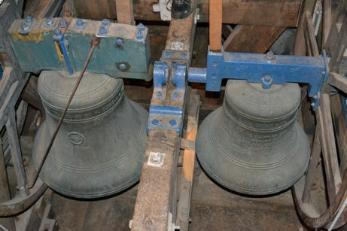
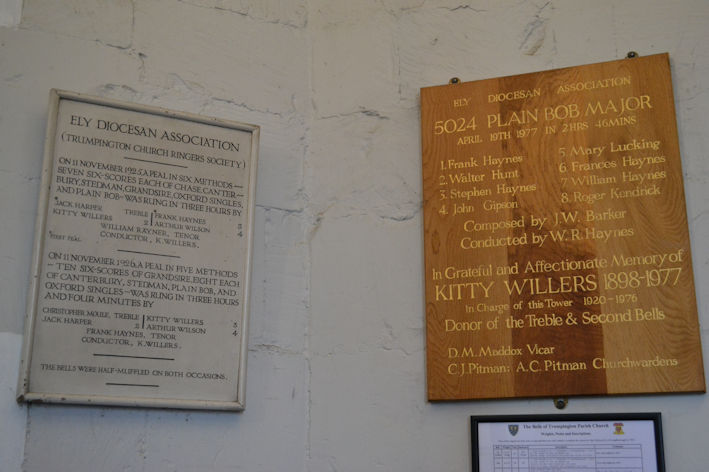
In late 1952, the Vicar, Rev. T. Young, addressed a bible class of teenage boys and asked for volunteers to become bellringers. He was met with stoney silence. Then the word went around that a girl was attending the bell ringing. There was nowhere in the village where boys could meet girls. A rush of acne pulsating, testosterone throbbing youths did not occur but my friend Michael and I went to a practice night. Indeed, there was a girl there, much of our own age and very attractive, we were hooked on bellringing!
Under Kitty Willers’ excellent tutelage we soon became quite proficient. There were 6 bells then ranging in weight from the smallest, or treble, at 4 cwt, to the tenor weighing in at 10 cwt or so. Kitty was a calm, experienced and knowledgeable teacher and knew how to get the best out of us. First, we learned how to handle a bell, for full circle bellringing, which takes knack rather than sheer strength. Then we joined in ringing the bells in sequence – rounds – with the already established local band which included Eustace and Dexter Bullman and Ted Haynes, as well as visitors who had come to help from Cambridge and other towers. Finally, we became change-ringers, where the bells were not rung in sequence but changed places in set patterns called methods that had to be remembered, and some were complex. If we got it wrong, Kitty would take a step forward and stamp her foot while putting us right, with raised voice but not ever actually shouting.
Thus bellringing not only exercised the body but the brain as well. Practice night was Wednesday and we rang on Sundays for Matins and Evensong, and would almost be always able to ring all 6 bells. We rarely stayed for morning services but trekked through the church to the north door, in front of much of the congregation, the only exit in those days.
Kitty, a stalwart of the church, always went to early morning communion, after which she would ascend the tower via the spiral staircase to the ringing room, then quickly up a steeply inclined ladder like a squirrel up a tree to the bell chamber, and finally up another steeply inclined ladder to the tower roof to put up the church flag, and then of course all the way down again. She was a maiden lady of indeterminate age, so this was a remarkable feat. Often at the end of Sunday evening ringing the three of us would take the flag down for her and if it was a fine evening, stay up there until the service finished, to chat, admire the view and look at the engraved representation of Ely Cathedral in one of the lead panels. It was said that, before some trees grew up, Ely could be seen from here. The incised picture was not convincing. If we stayed in the ringing chamber, we had to be circumspect as the floor in those days was not carpeted and there were complaints of noise.
We continued thus for several years, until that sad day when the fifth bell suddenly cracked. It was an historic bell that could not be melted down and it was consigned to a dark corner of the church at that time. Funds were raised to replace it and Kitty took the opportunity to donate two new bells in memory of her parents. The remaining bells were taken down for re-tuning. An excursion was arranged to see all the bells at John Taylor’s Bell Founders in Loughborough.
The great day came when the bells were returned, as recorded by a Cambridge newspaper, and rehung over the following week. The first peal rung on the augmented 8 bells was of a method called Grandsire Triples, being 5040 changes taking over 3 hours in which I participated on 1 February 1958. Sound shutters over the louvres in the bell chamber could be closed during prolonged ringing to minimise the sound outside.
Circumstances took me away from Trumpington, leaving a thriving bell ringing band which I heard had gone from strength to strength.
I finally gave up ringing last year (2025), 72 years after being introduced to it by two contrasting wonderful women!
Kitty Willers and Cycling
Much has been written about Kitty Willers’ long distance pedal cycle rides from her home to various bell ringing events in the county and beyond. As an example, one ride was to the bell foundry in Loughborough to see Trumpington’s refurbished ring of bells but especially the newly cast ones. We mere mortals went by car!
I vaguely remember that it was a Wednesday, and we know that she set out at 4 am. My estimation, with roads as they were then, is that the shortest route was 85 miles and if Kitty went another way, or had navigation problems, as much as 100 miles.
A pedal cyclist, not in a hurry, usually travels at 12-15 miles an hour. Kitty, in her mid-50s, would have been easily able to do this, in spite of voluminous skirts and an older type of bicycle, at least for the first couple of hours through relatively flat Cambridgeshire and Huntingdonshire. When it became more hilly, and as time went by, I would guess her speed would have dropped to 10 miles an hour and even less on the approach to, and within, Loughborough itself. I think she would have arrived at the foundry at around 11 am or so, having been in the saddle for about 7 hours, excluding breaks. A fantastic, prodigious achievement.
Then there was the return journey, another 7 hours at least to pedal her cycle. She may have been offered a lift home but she was well known for politely refusing such help. Perhaps someone is able to enlighten me?
Assuming she cycled home, she would then have had more than 14 hours in the saddle in one day and covered between 150 and 200 miles.
Utterly amazing, what a determined, magnificent woman!
Additional information